
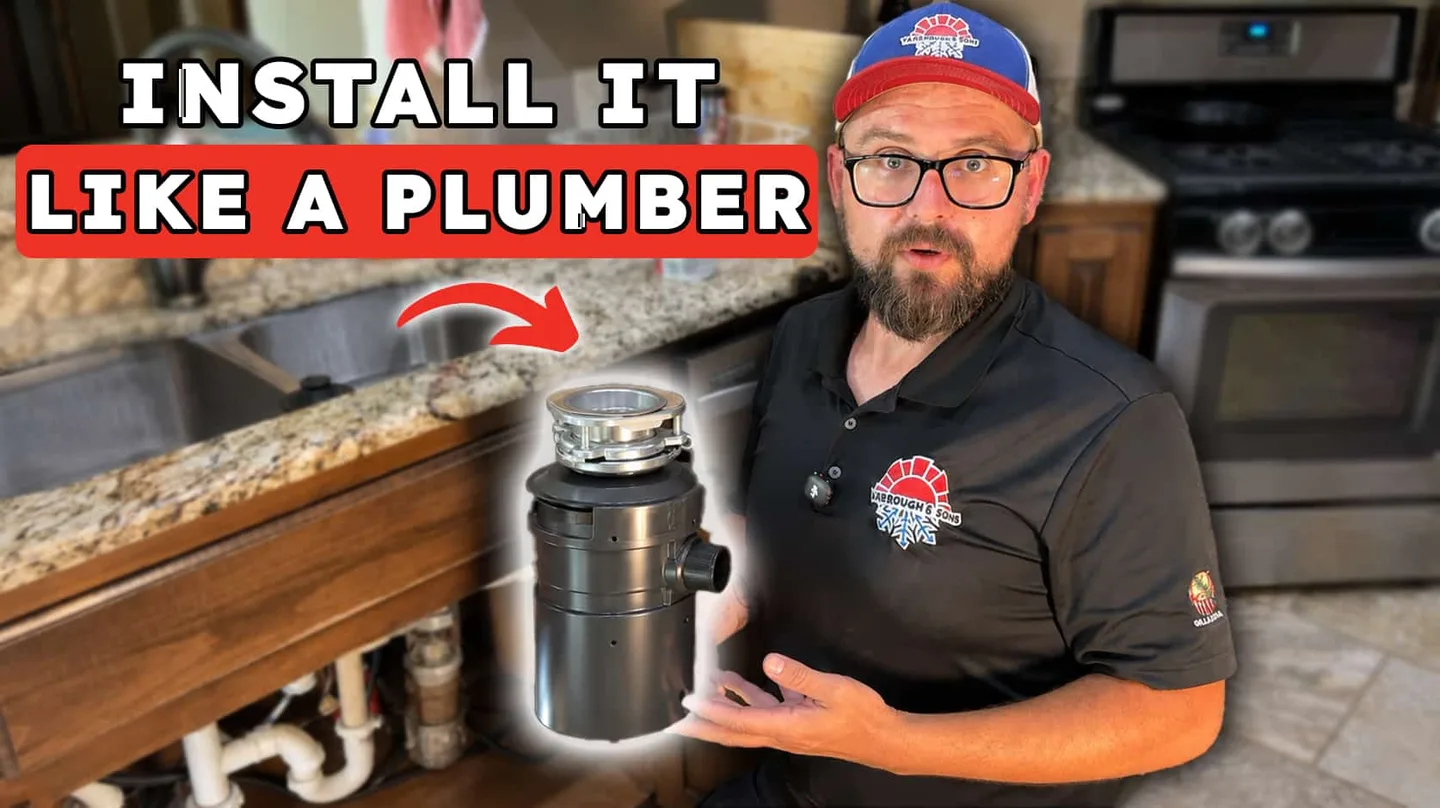
Garbage disposal replacement cost runs from $550 for a builder-grade 1/3 HP unit up to $1,950 for a 1 HP chef-grade unit here in the Oklahoma City metro - and that’s installed, with the disposal itself and the labor both included. Most of the kitchens I work in land in the lower half of that range, because most homes genuinely don’t need a 1 HP motor.
I’ve pulled and set more of these than I can count, and the swap itself takes me about 20 to 30 minutes when the drain under the sink is in decent shape. What moves the price is everything around the disposal: a corroded sink flange, a dishwasher drain that was never hung right, a tailpiece that has to be rebuilt, or an old unit that was hardwired instead of plugged in.
Key takeaways
- Installed garbage disposal replacement cost: from $550 to $1,950 in the OKC metro, unit and labor included.
- 1/3 to 1/2 HP handles almost every Oklahoma kitchen. A 1 HP unit is a want, not a need - I put those in when somebody cooks hard, not because the house requires it.
- Try the hex key and the red reset button first. Both are on the bottom of the unit, both are free, and both fix a surprising number of “dead” disposals.
- Rust on the body or water dripping from the bottom means replace, not repair. Once the internal seals corrode through, no amount of tightening fixes it.
- If the sink drains slow but the disposal spins fine, the disposal isn’t your problem - you’ve got a clog downstream, and snaking starts at $300.
Garbage Disposal Replacement Cost in the OKC Metro (2026 Pricing)
These are our real installed prices, not a national average. The garbage disposal replacement cost we quote covers the new unit, hauling off the old one, a new sink flange set in fresh putty, reconnecting the tailpiece and P-trap, re-hanging the dishwasher drain, and a fill-and-drain leak test before I pack up.
| What you’re getting | Motor | Installed price | Who it’s for |
|---|---|---|---|
| Builder-grade continuous feed | 1/3 HP | From $550 | Rentals, light cooking, one or two people in the house |
| Standard residential upgrade | 1/2 HP | Between $550 and $1,950 | The sweet spot for most family kitchens |
| Chef grade, high torque, sound insulated | 1 HP | Up to $1,950 | Heavy daily cooking, big households, quiet operation |
| Kitchen drain snaking (add-on, if the clog is past the disposal) | - | From $300 | Slow-draining sinks with a working disposal |
| Main sewer line snaking (add-on) | - | From $350 | Backups showing up at more than one fixture |
Prices are current for 2026 and cover Blanchard, Newcastle, Norman, Moore, Yukon, Edmond, Purcell, Mustang and the rest of the OKC metro. You can explore an estimate with our Instant Estimate.
Why a Licensed Plumber Costs More Than the $300 You Saw Online
Search this topic and you’ll see national averages in the $200 to $625 range. That number is a blend - it mixes handyman hourly labor, big-box install fees, and DIY unit-only costs into one figure. It isn’t a licensed plumber’s price for a warrantied job.
Our garbage disposal replacement cost starts at $550 because that price carries the unit, a licensed plumber’s time, and warranty backing if something under your sink lets go six months from now. We publish exactly how that math works on our transparent pricing page, and we broke the whole model down line by line in HVAC Pricing Explained. Short version: on a typical plumbing job, parts and direct labor are less than half the ticket. The rest is overhead, warranty reserve, and keeping a stocked truck and a real person answering the phone.
What Actually Drives Your Garbage Disposal Replacement Cost
Two identical disposals can be two different invoices. Here’s what changes the garbage disposal replacement cost once I’m under the sink:
- Motor size. The single biggest variable. Going from 1/3 HP to 1 HP is most of the spread in the table above.
- Whether the old drain can be reused. A like-for-like swap reuses the tailpiece and P-trap, so the drain lines go back roughly where they were. Change unit size or brand and I may be rebuilding that assembly.
- The condition of the sink flange. Rusted mounting hardware and hardened old putty add real time, and sometimes the whole mounting assembly has to go.
- How the dishwasher drain was hung. More often than not, the last person left it drooping. Rehanging it correctly is part of doing the job right, not an upsell.
- Plug-in versus hardwired. The units we stock come with the power cord already wired on, so a plug-in swap is straightforward. If your old disposal was hardwired into a junction box, that’s electrical work, and it adds to the ticket.
- Cabinet access. A deep double-bowl sink over a cramped cabinet takes longer than an open single bowl. Physics.
Before You Pay for Anything, Try These Two Free Fixes
I’d rather tell you this up front than take a service call for it. If your disposal hums but won’t grind, or does nothing at all, reach underneath the unit before you shop for a new one.
- The hex key. Every new disposal ships with a small Allen wrench, and there’s a matching socket in the center of the bottom of the unit. Seat the key and rock it back and forth. That turns the motor and flywheel directly, and most of the time it breaks a jam loose.
- The reset button. Also on the bottom, usually red. Press it in. Disposals trip their own overload protection constantly, and a tripped unit sounds exactly like a dead one.
Kill the power at the switch or unplug it first either way. And if the motor runs fine but the basin still drains slowly, the disposal isn’t the culprit - the clog is downstream in the drain line, which is a drain cleaning job starting at $300, not a $550 replacement.
When Rust Means Replace, Not Repair
My rule is simple: if there’s rust on it, replace it before it turns into a bigger problem. A disposal that’s weeping now is a flooded cabinet and a swollen sink base later. Replace rather than repair when you see:
- Water dripping from the bottom of the unit, near the reset button - that’s the internal seal, and it isn’t serviceable
- Rust bleeding through the housing or crusted around the mounting hardware
- A hum that the hex key won’t clear, which usually means the motor is done
- Grinding that’s gotten noticeably weaker and slower over the last year
- A unit past the 8-to-12-year mark that’s already needed one repair
What Size Garbage Disposal Do You Actually Need?
What we install in residential homes is 1/3 to 1/2 horsepower. That’s it. Plenty of online guides will push you toward 3/4 or 1 HP, and I’ve pulled out oversized units that somebody sold a homeowner for no reason - the one in the video was a 1 HP, and it was a big, bulky thing to fight with in a cabinet.
A bigger motor doesn’t grind “better” for normal kitchen scraps. What you actually get for the money is more torque for stringy and fibrous waste, plus better sound insulation. If you cook hard every night, that’s worth it. If you scrape plates into it a few times a week, it isn’t - and motor size is the largest single line item in your garbage disposal replacement cost, so that’s real money either way.
On brand: I like InSinkErator, and the Badger line specifically. They hold up, parts are everywhere, and the models we stock come with the power cord already wired on - which keeps a straightforward swap from turning into an electrical job.
What the Job Actually Involves (and Where DIY Goes Wrong)
A straight swap is within reach for a handy homeowner. Here’s the whole job on video, then the honest sequence, condensed:
Professional demonstration, not a DIY repair guide. Leave electrical, refrigerant, gas, combustion, and specialized installation work to a qualified professional.
- Unplug it. Water and power don’t mix. This is not the step to get casual about.
- Bucket and gloves. Loosen the two slip nuts on the P-trap and pull it down. It’s full of water, and it’s nasty in there.
- Pop the dishwasher hose off the inlet fitting, then twist the mounting ring loose and lower the old unit out. If your sink is a double bowl, set it in the other basin so it drains somewhere useful.
- Scrape the sink clean. Old putty and dried silicone all have to come off before the new flange goes down. A wet rag finishes it.
- Roll a rope of plumber’s putty, ring the drain opening with it, and press the new flange in. The tighter you draw it down, the more the putty squeezes out to make the seal.
- Rebuild the mount underneath in order: fiber gasket, backup flange, then the mounting ring - and last, the snap ring into its groove. That retaining ring is the fussiest part of the whole job. A flat-tip screwdriver, one side started, then work it around until it pops in.
- Tighten the three mounting screws a little at a time, rotating between them like lug nuts on a wheel, until the tips sit flush with or past the bracket.
- Knock out the dishwasher plug in the side of the new unit - then fish the loose slug out of the grinding chamber.
- Hang the new disposal, reconnect the tailpiece and P-trap, re-hang the dishwasher hose in a high loop, plug it in, and test.
My trick for working alone: once the new flange is bedded in putty, set the new disposal on top of it from above. The weight holds everything down while you fight the snap ring from underneath.
The five mistakes I get called out to fix
- The dishwasher knockout plug. Either it never got punched out, or it got punched out and left rattling around inside. Either way the dishwasher can’t drain, and that water ends up in the cabinet.
- No high loop. The dishwasher drain hose has to loop up above the disposal so sink water can’t siphon back into the dishwasher. Oklahoma builds to the International Plumbing Code adopted by the OUBCC, which is why we use a secured high loop rather than a countertop air gap on most kitchens here.
- Channel locks on the slip nuts. Those plastic nuts are thin and they crack. Hand-tight is tight enough.
- An impact driver on the mounting screws. It’s easy to get carried away and overtighten, which distorts the flange and starts a slow leak. Do that part by hand.
- Skipping the leak test. Plug the drain, fill the basin, and watch the flange for five minutes. Then pull the plug and send all of it through the P-trap at once. If it’s going to leak, make it leak while you’re still under there.
One more: never run a disposal dry. Cold water should be going every time it’s switched on.
Garbage Disposal Replacement Cost FAQ
What is the average garbage disposal replacement cost in Oklahoma City?
Our installed garbage disposal replacement cost starts at $550 and tops out at $1,950 for a 1 HP chef-grade unit. Most OKC metro homeowners land nearer the floor than the ceiling, because a 1/3 or 1/2 HP unit is what the majority of these kitchens actually call for.
How long should a garbage disposal last?
Eight to twelve years is typical. Hard water shortens it, and so does a household that treats it like a trash can. Corrosion is usually what ends them, not the motor.
Is it worth repairing a garbage disposal instead of replacing it?
A jam or a tripped overload is free to fix yourself, so always try that first. But there’s very little inside a disposal that’s economically repairable. Once the motor is gone or the bottom seal is leaking, replacement is the cheaper answer.
Can I replace a garbage disposal myself in Oklahoma?
A like-for-like swap on an existing plug-in outlet is a homeowner-level job - that’s exactly what we walked through in the video. Cutting in new drain lines, or wiring a new circuit or switch, is licensed plumbing and electrical work and shouldn’t be a weekend experiment.
How long does a professional replacement take?
Twenty to thirty minutes for a clean swap. Add time for a corroded flange, a rebuilt drain assembly, or a dishwasher line that has to be re-hung properly.
What shouldn’t go down a garbage disposal?
Grease is the worst offender, because it goes down warm and hardens in the drain line downstream. Also skip coffee grounds, eggshells, bones, fruit pits, and fibrous stuff like celery, corn husks, and onion skins. Rice and pasta swell after they’re past the disposal, which is where the real clog forms.
Explore Pricing With Our Instant Estimate
If the swap is beyond what you want to take on - and plenty of the ones I do every year are jobs homeowners started and then called us about - we’ll handle it. Our licensed plumbers have been under sinks across the OKC metro since 1988, and you’ll get your exact garbage disposal replacement cost before anyone touches a wrench.
Use the Instant Estimate for a real price online, or call (405) 960-3470 and we’ll get you scheduled. Financing is available if you’re bundling the disposal with other plumbing work.