
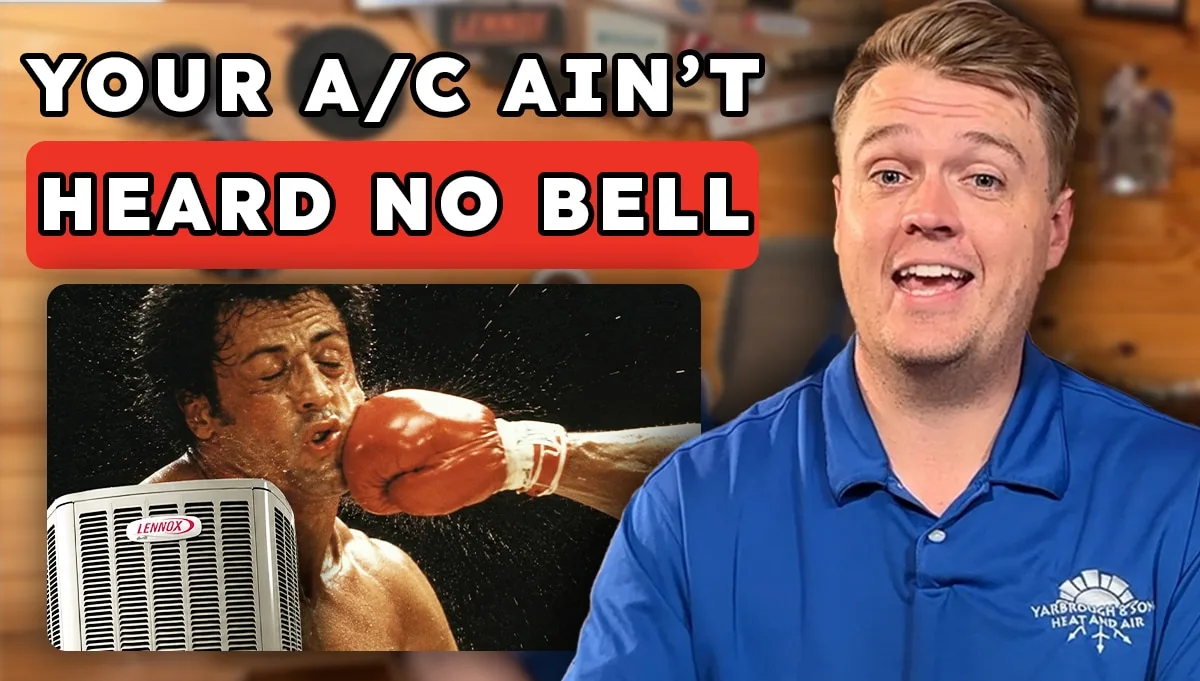
Here’s what nobody tells you about a late summer AC breakdown: your air conditioner is much more likely to die at the end of the season than the beginning. It’s been in a heavyweight fight since May, and like Rocky in the seventh round, it ain’t heard no bell. School’s back, football’s about to be on the television, and everybody’s talking about the “burr months” - but you live in Oklahoma. It’s going to be 90-plus degrees until October, and your system still has a lot of rounds left to go.
I’m going to walk you through why systems give up late in the season, the three failure points we see every August, what each one costs to fix, and the cheap checks you can make yourself before you ever pick up the phone.
Key Takeaways
- An Oklahoma air conditioner cycles on and off roughly 12 to 16 times a day, and startup is the hardest moment in the whole cycle. Weak parts survive June and die in August.
- The capacitor is the number one late-season casualty. Replacing one generally runs $250 to $350.
- Skipped maintenance comes due at the end of summer: a dirty filter, a caked outdoor coil, and a clogged drain line all push a tired system over the edge.
- A drain line float switch typically costs $200 to $500 installed - the cheapest insurance policy in HVAC against a $5,000 ceiling repair.
- Grinding, screeching, or banging noises mean call a pro now. Ignoring them can turn a $500 to $600 repair into a $2,500 to $5,000 compressor replacement. Our diagnostic is $119, applied to the repair.
Why the Late Summer AC Breakdown Is So Common in Oklahoma
Your air conditioner has been running all summer long. On an average Oklahoma day it cycles on and off about 12 to 16 times, and the startup is the hardest part on the entire system - that’s the moment every electrical component gets hit the hardest. Multiply that by a hundred days of heat and you can see why a part that was merely weak in June is flat-out done by mid-August.
Think of it like a race car at the end of the race. Everything’s hot, everything’s tired, and you’re just trying to get it home. If a component was going to fail, late summer is when it happens - right when you need cooling most and right when every HVAC company’s phone is ringing off the hook.
Failure Point #1: Your Capacitor Is Out of Rounds
A capacitor is basically a battery. It gives your compressor and fan motors a little kick in the pants - just enough juice to start properly. The problem is that it retains heat, and inside that little can there’s real chemistry going on. When it gets too hot too many times, it starts to expand and swell up like a balloon. If you’ve never seen an aluminum balloon before, go look at a failed capacitor. That’s probably what yours looks like right now.
Here’s the part people miss: the capacitor is only involved in startup, so it feels like it shouldn’t wear out. But startup is the single hardest moment on the system, and your capacitor eats that hit 12 to 16 times a day, all summer. It degrades over time the same way an electric car battery does, and its strength is measured in microfarads. If it didn’t fail early in the season, it was Rocky in the first round - looking great, not covered in blood yet. Seven rounds into a triple-digit summer is a different story.
Replacing a capacitor generally costs $250 to $350, and it’s one of the most common repairs we make in August. We covered the full breakdown in our post on what an AC capacitor costs to replace.
A word to the DIY Dans out there: if you decide to swap your own capacitor, don’t grab the biggest, baddest one on the shelf. Bigger is not better. A capacitor has to be properly sized - match the microfarad rating and the voltage exactly, or you can shock your compressor with more than it’s built to take. And remember you’re dealing with high-voltage electricity, so if any part of that makes you hesitate, this is a quick, inexpensive call for a technician.
Failure Point #2: Skipped Maintenance Comes Due in August
If you had your system maintained before summer, you’re far less likely to be reading this with sweat on your brow. If you didn’t, neglected maintenance encourages exactly the kind of minor component failures - capacitors, contactors - that take systems down late in the season. Three things do most of the damage.
Your filter is probably dirty
Change your filter, you filthy animal. If you can’t see light through it, it’s time. During summer, change it once a month - the extra runtime clogs it faster than any other season. If you want to stretch it to every three months in spring, that’s between you and God. During an Oklahoma summer, it’s between you, me - your HVAC guy - and your system.
Your outdoor coil has been Pac-Manning cottonwood all summer
If you’ve got cottonwoods like we do around here, your outdoor unit has been inhaling cottonwood seed, grass clippings, and dust since May. A caked coil is bad at heat transfer. Bad heat transfer means the system runs hotter. Running hotter puts more strain on the capacitor and contactor, which puts more strain on the fan motor and compressor - and that chain ends with hotter refrigerant, a less efficient air conditioner, a less cool you, and a system that’s frankly more likely to break down. Every professional maintenance includes cleaning that coil, and if you want to handle it yourself, here’s how to clean your AC condenser coil the way a pro would.
Your drain line is one clog away from a ceiling repair
Holy Moses, the drain line. Algae builds up in a neglected condensate line until it looks more like the stagnant pond behind your neighbor’s place than a drain. At maintenance we drop pan tabs in the indoor coil and shop-vac the line clean so nothing sits stagnant in there.
But the real unsung hero is the emergency float switch. It shuts the system down before a backed-up drain overflows, and it typically costs $200 to $500 installed depending on the switch. That is the cheapest insurance policy in this trade - because the alternative is the condensate backing up over a holiday weekend, the sheetrock coming down wet right as company arrives, and Grandma not getting her peanut butter pie. We’ve watched a couple-hundred-dollar upgrade that never happened turn into a $5,000 ceiling repair. Most Oklahoma systems sit up in an attic, which makes a float switch non-negotiable in my book. If nobody has ever offered you one at a maintenance visit, shame on whoever did your maintenance.
Check the Cheap Stuff First
If you’re staring down a late summer AC breakdown right now, check the free-and-easy items before you call anybody:
- The filter. Can’t see through it? Change it.
- The outdoor coil. If it’s fuzzy with cottonwood and grass, it can’t breathe.
- The emergency drain pan. Standing water or water stains under an attic unit mean the drain line is backing up.
Those three checks solve a surprising share of end-of-summer complaints. For the full symptom rundown, see the eight most common AC problems Oklahomans face.
When to Bring In a Tech
Clanking. Banging. Grinding. Screeching. If your air conditioner is making noises you’d describe with a wince, something larger is going on - usually a fan motor bearing or a compressor with failing valves or bad refrigerant pressures. I know how it goes: you’re lying in bed, the compressor kicks on sounding like a car doing a burnout, and you think, “Maybe if I ignore it, this is a next-summer-me problem.” If this-summer-you ignores it, it will absolutely be a problem - and probably a this-fall problem, because that compressor is on its way out.
The napkin math is simple. Catch a noisy compressor early and you’re often looking at a $500 to $600 repair. Ignore it until it seizes and you’re looking at a $2,500 to $5,000 compressor replacement. Nobody needs a calculator to know you don’t want to 10x a repair bill unnecessarily. Our AC repair diagnostic is $119, and we apply it to the repair if you move forward.
Late-Season Failure Points at a Glance
| Failure Point | Early Warning Sign | The Fix | Typical Cost |
|---|---|---|---|
| Weak capacitor | Hard starts, humming outdoor unit, swollen top on the capacitor | Replace with a properly sized capacitor | $250–$350 |
| Dirty outdoor coil | Longer run times, weaker cooling, rising bills | Coil cleaning (included in a tune-up) | Tune-up from $189 |
| Clogged drain line | Water in the emergency pan, musty smell near the unit | Clear the line and add an emergency float switch | $200–$500 installed |
| Failing compressor | Grinding, screeching, or banging at startup | Catch it early - repair beats replacement | $500–$600 early vs. $2,500–$5,000 if it fails |
| Dirty filter | You can’t see light through it | Change it monthly during summer | DIY |
Every repair gets upfront pricing before any work begins, and the $119 diagnostic fee is applied toward the repair.
How to Make It to October
Here’s the good news: almost every late summer AC breakdown we run a truck to was preventable. The end-of-summer checklist isn’t about squeaking by - it’s about making sure a small, fixable issue doesn’t become a big-ticket repair or a full replacement. Control what you can control: change the filter monthly, keep the coil clean, and get eyes on the drain line. The U.S. Department of Energy’s guide to maintaining your air conditioner backs up the same fundamentals: airflow and clean coils are most of the battle.
If you’d rather have us handle the blocking and tackling, our Maintenance Membership is $300 per year and covers both seasonal tune-ups - one for the AC, one for the heater - plus a 20 percent discount on any HVAC or plumbing repair and priority scheduling. Priority scheduling matters most in exactly these weeks, when every phone in the metro is ringing.
Late Summer AC Questions We Hear Every August
Why does my AC break down at the end of summer instead of the beginning?
Cumulative wear. By August your system has started and stopped well over a thousand times since spring, and startup is the hardest moment on every electrical component. Parts that were weak in June - especially capacitors - finally give out late in the season. That’s the whole anatomy of a late summer AC breakdown.
How often should I change my filter during an Oklahoma summer?
Once a month. Summer runtime clogs filters faster than any other season, and a clogged filter strains every component downstream of it.
Can I replace my own AC capacitor?
A capable homeowner can, but you’re dealing with high-voltage electricity, so respect it. Match the microfarad rating and voltage exactly - never upsize - and follow a credible walkthrough. If you’d rather not gamble, we replace capacitors every day; it generally runs $250 to $350.
Is it worth repairing my AC this late in the season?
Yes. Oklahoma stays 90-plus into October, so “almost fall” still means weeks of hard runtime. And a system limping into autumn doesn’t heal over the winter - it fails on the first hot week next year, usually as a bigger bill.
What does a grinding or screeching noise from my AC mean?
Usually a fan motor bearing on its way out or a compressor with internal trouble. Shut the system off and get it looked at - that noise is the difference between a few hundred dollars now and a few thousand later.
Watch: Your AC Ain’t Heard No Bell
Don’t let your air conditioner tap out in the seventh round. Yarbrough & Sons has been keeping Blanchard, Norman, Moore, Newcastle, Tuttle, Yukon, and the rest of the OKC metro cool since 1988 - and we’ll get you to October. Call (405) 960-3470 or explore estimated pricing with our Instant Estimate.
And do something nice for somebody today. You never know - it might change their life.