
What HVAC System Should You Actually Buy in 2026?
Homeowner Tips & News

Family Owned & Operated

Trusted & Highly Rated Service

Responsive & Timely Service
Family Owned & Operated
Trusted & Highly Rated Service
Responsive & Timely Service
What HVAC System Should You Actually Buy in 2026?
Between global tariffs, massive refrigerant updates, and unpredictable regulatory changes, buying an HVAC system in 2026 can feel a bit like trying to play a game where the rules keep changing and the referees are toddlers.
If you are trying to figure out which way is up, you aren’t alone. To bring some sanity back to the process, here are the 11 critical points you must consider to protect your home comfort and your wallet this year.
1. Don’t Wait: Prices Will Never Be Cheaper Than Today
If you’ve been holding off on a replacement since 2022 or 2024 hoping prices would drop, it’s time to face reality. The global tariffs implemented over the last year drastically drove up the cost of raw manufacturing materials like steel, copper, and tin. Sinking money into a dying system to “wait out the market” is a losing strategy; a replacement in 2026 will always be more cost-effective than waiting until 2028.
2. Milk Your Local Utility Incentives
Utility companies don’t actually want you wasting energy—they want to maintain a stable power grid so they can manage peak usage and, in cases like Oklahoma’s OG&E, sell excess power to neighboring states. Because of this, companies like OG&E and Oklahoma Natural Gas offer substantial cash incentives and rebate plans to help you upgrade to high-efficiency equipment. Always ask your contractor to maximize these rebates for you.
3. Variable Capacity is the Reliable Hero
If you are moving away from an old, single-stage system (which operates like a basic light switch—either 100% on or 100% off), a variable capacity system is a life-changer. Instead of harsh temperature swings, variable capacity units feature hundreds of tiny stages of capacity. They run smoothly at lower speeds, keeping your indoor climate perfectly consistent while actively shielding you from fluctuating energy bills.
4. Choose the Best Bid over the Lowest Bid
The “sweetness” of a rock-bottom price wears off long before the bitterness of a terrible installation sets in. In this industry, ultra-cheap companies rarely stay in business long enough to honor their labor warranties, leaving reputable contractors to pick up the pieces later. Don’t let upfront sticker shock bully you into a corner; buy a system you’ll still be happy with 7 to 10 years down the road.
5. Expose the “Lead Gen” Price Myths
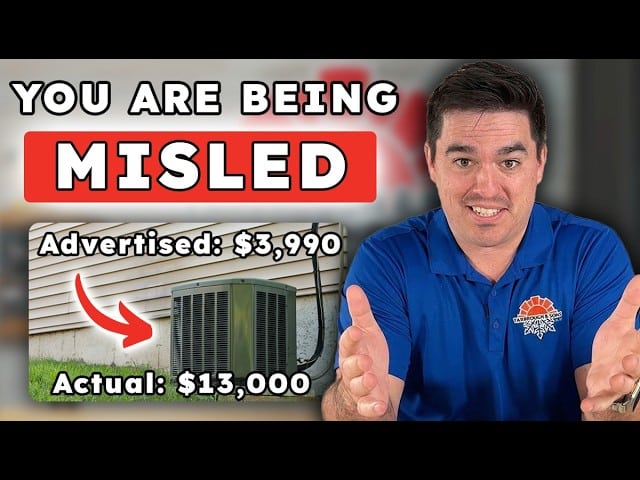
Websites like Angie’s List and HomeAdvisor are not HVAC companies—they are lead aggregators after your data and clicks. They frequently list average central air installations at an unrealistic $3,900 to $7,900.
The Real 2026 Data: National project trackers like Modernize, analyzing over 56,000 real-world installations, place the actual average cost between $11,590 and $14,000. Don’t fall for clickbait baselines that only exist to break your heart when a real professional hands you an honest quote.
6. Demand the Newest Refrigerants (R-32 or R-454B)
The EPA phase-out of R-410A is well underway. While R-410A refrigerant will still be produced for existing units, its dwindling supply will cause its price to skyrocket over the next decade. When buying an HVAC system this year, make sure it utilizes the new standard A2L refrigerants: either R-32 or R-454B. This future-proofs your investment against predatory environmental tax hikes.
7. The Crew Matters More Than the Brand Name
You can buy the most expensive, top-tier brand on the planet, but if it is installed poorly, it will fail. Brand stickers matter significantly less than a five-star qualified crew. Look for contractors who analyze your home’s total static pressure and ductwork rather than box-swappers who ignore air dynamics just to get to the next job quickly.
8. Learn to Spot What “Cutting Corners” Looks Like
If a bid looks suspiciously cheap, ask yourself what they are leaving behind. Cutting corners looks like:
- Reusing a 30-year-old furnace while swapping the outdoor AC.
- Replacing a dead compressor without changing the indoor evaporator coil.
- Increasing equipment size to solve a comfort issue without calculating whether your existing ductwork can handle the extra air.
9. Use Creative Financing to Shift the Math
Because HVAC breakdowns are often sudden, stressful emergencies, paying in a single lump sum isn’t always practical. Look for stable contractors with strong banking and credit union relationships. For instance, smart companies offer structured 0% interest plans for up to 72 months, or long-term 2.99% low-interest options over 10 years that keep your monthly payment well below your summer electric bill savings.
10. Buy in the “Shoulder Seasons”
If your system is functional but on its last legs, schedule your replacement during the spring or fall. Once the peak summer heat waves roll in, high-quality teams will be completely swamped with emergency “no-cooling” calls. Replacing your system during a mild shoulder season gives the installation crew the luxury of time, keeps them out of a 140°F attic, and ensures you get top-priority scheduling.
11. The Insider Formula: What a Pro Builds
When building a custom home project recently, here is exactly what I chose for my own family:
- A Lennox 22 SEER variable-capacity heat pump.
- A Dual-Fuel setup (pairing the ultra-efficient electric heat pump with a propane gas furnace for optimal winter performance).
- A high-efficiency media filtration system supplemented by an ionization system to completely neutralize severe seasonal allergies.
We will never recommend a solution for your home that we wouldn’t happily install in our own. Modern 2026 equipment is miles ahead of systems built 12 to 15 years ago—embrace the technology and do it right.
Get a Transparent Price in Seconds
Tired of the middleman games and high-pressure sales pitches? We believe you should know what things cost without a salesperson sitting on your couch for two hours.
If you are in the Oklahoma City metro area, click to use our Instant Pricing Tool and see exactly where you stand in less than two minutes.
Proudly Serving Communities Throughout The Oklahoma City Area
Our Service Area
 All Service Areas