
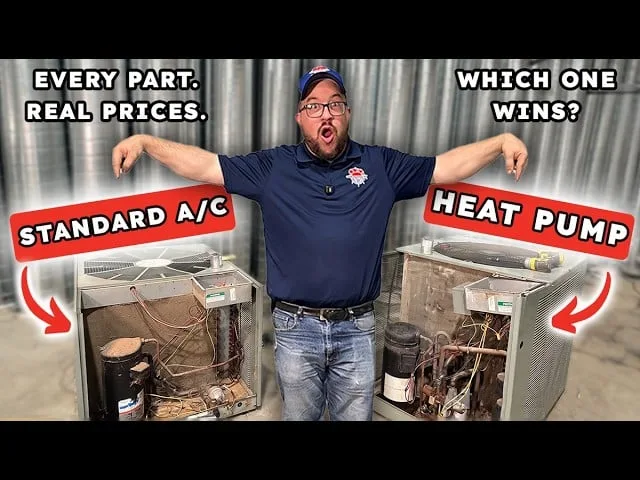
If your cooling system is reaching the end of its life, you face a major mechanical choice that most homeowners don’t even know exists: Should you replace it with a standard air conditioner or upgrade to a high-performance heat pump?
To the untrained eye, the outdoor metal boxes look exactly the same. However, inside the cabinets, the rules are completely different. A standard AC unit is a one-way street designed strictly to move heat out of your house. A heat pump is a two-way climate machine that cools your home in July and handles your heating needs when the winter cold snaps hit.
To help you understand exactly what you are paying for, we are stripping down both cabinets and comparing them side by side, component by component, with real-world 2026 repair and replacement costs.
Shared Baseline Components (Found in Both Systems)
Before looking at what makes a heat pump unique, we have to look at the baseline electrical and mechanical “bones” that both standard air conditioners and heat pumps rely on to operate.
1. The Compressor (The Heart)
The compressor is the heavy, high-voltage pump responsible for pressurized circulation of refrigerant throughout the indoor and outdoor coils.
- The Tech: Most units from the last 15 years utilize a scroll compressor, though modern manufacturing is shifting toward ultra-efficient rotary compressors.
- Out-of-Warranty Cost:$4,000+ * Under-Warranty Labor Cost:$2,000
- Side-by-Side Difference: None. Both systems use identical compressor logic, though a heat pump compressor works harder year-round because it operates during both the cooling and heating seasons.
2. Dual Run Capacitors (The Battery Regulator)
The capacitor acts like a continuous battery storage cell that regulates power surges and drops, providing the smooth electrical phase-shift required to keep the fan motor and compressor spinning within factory specs.
- The Spec: Measured in microfarads (e.g., a “60 x 5” or “80 x 5” split model for compressor/fan paths).
- Replacement Cost:$250+ * The Pro Tip: Heat is the ultimate killer of capacitors. Avoid cheap imports. A professional should always install premium, heavy-duty American-made capacitors that utilize synthetic oils rather than bean oil to dissipate internal thermal stress.
3. The Contactor (The High-Voltage Switch)
Think of the contactor as a mechanical light switch. When your indoor thermostat sends a low-voltage (24V) signal to the outdoor unit, a magnetic coil pulls down the heavy metal contact points, allowing high-voltage electricity to flood your compressor and fan.
- The Problem: Constant arcing causes metal pitting, which eventually prevents a clean electrical connection.
- Replacement Cost:$325 (Expected lifespan: 5 to 10 years depending on preventative maintenance checks).
4. Hard Start Kits (The Start-Up Oomph)
A hard start kit is an aftermarket or factory-installed capacitor and relay combo that gives the compressor an extra electrical surge at startup, allowing it to reach maximum velocity instantly without drawing excessive starting amps.
- The Benefit: It minimizes the crushing physical friction and thermal shock your compressor experiences during startup.
- Installation Cost:$340 (Highly recommended for any standard efficiency unit to protect an out-of-warranty compressor from locking up).
5. Service Valves and Schrader Cores
These are the physical connection ports that allow a licensed technician to attach gauges, check operating pressures, recover old refrigerant, and pull a clean deep vacuum.
- The Failure Point: The internal Schrader cores leak constantly if left uncovered. Ensure your technicians tighten the heavy brass caps to hand-tight plus 1/6th of a turn to keep the system sealed.
- Schrader Replacement Cost:$150 (Refrigerant leaks destroy operating efficiency and cause your compressor to run dangerously hot).
The Heat Pump Exclusives (The Extra Parts You Pay For)
This is where the line of demarcation happens. A heat pump features specialized engineering paths and automated circuit controls that allow the refrigeration cycle to run completely backward.
6. The Reversing Valve (The Gold Standard)
Also known as a four-way valve because of its four separate copper pipe connection joints, this component is the single part that makes a heat pump a heat pump.
- How it works: It utilizes an external electrical solenoid slider to physically redirect the hot, high-pressure discharge gas leaving the compressor. In the summer, it sends that gas to the outdoor coil to dump heat outside. In the winter, it slides open to send that hot gas straight to your indoor coil to heat your home.
- Replacement Cost:$2,500 (An expensive, labor-intensive repair requiring complex system evacuation, copper brazing, and fresh refrigerant).
7. The Defrost Board
Because an outdoor heat pump coil acts as an evaporator during the winter, its temperature rapidly drops well below freezing, causing ice and frost to accumulate on the outer aluminum fins.
- How it works: The defrost board is an outdoor computer that monitors temperature thresholds. When ice gets too thick, it automatically flips the reversing valve back into “cooling mode” for a few minutes. This sends hot gas outside to flash-melt the ice.
- The Phenomenon: During defrost, the outdoor fan shuts off completely, and clouds of thick steam will billow out of the cabinet. Don’t panic - the unit is not on fire; it is just self-cleaning.
- Replacement Cost:$550 to $1,000+ (Highly sensitive to electrical lightning strikes; always protect this board with an active surge protector).
8. Bi-Flow Liquid Line Driers
All professional installations require a line drier to catch particulates and absorb structural moisture before it can combine with system oils to form dangerous acids.
- The Difference: Standard air conditioners use a cheap, one-directional filter drier. If you run refrigerant backward through a standard drier, it will clog completely. A heat pump requires a specialized bi-flow drier that filters effectively regardless of which way the valve redirects the fluid path.
- Replacement Cost:$800 – $1,400 (Must be swapped every single time a technician cuts open the closed refrigerant loop).
9. Outdoor TXV (Thermal Expansion Valve)
While a standard cooling setup only uses a metering device inside the house, a heat pump requires a secondary metering valve outside to regulate refrigerant expansion when operating in heating mode.
- Replacement Cost:$2,000 (Rarely fails unless copper vibration rubs a hole into the capillary sensing tube).
Component Comparison Summary
| Component | Standard AC Unit | Heat Pump System | Real-World Function / Repair Cost |
| Compressor | Yes | Yes | Pressure heart of system / $4,000 out of warranty |
| Reversing Valve | No | Yes | Diverts refrigerant flow / $2,500 replacement |
| Defrost Control Board | No | Yes | Manages outdoor winter de-icing / $550 – $1,000 |
| Filter Drier Type | Mono-Directional | Bi-Flow | Traps moisture and debris / $800 replacement |
| Outdoor Metering (TXV) | No | Yes | Regulates winter thermodynamic expansion / $2,000 |
| Winter Fan Blade Ice Risk | No | Yes | Can warp blades or dent coils if freezing rain hits |
The Financial Verdict: Which One Should You Buy?
Because a heat pump requires heavier manufacturing, structural sensors, and automated microprocessors to navigate the cold winter elements, it commands a higher upfront cost.
- Average 3.5-Ton Standard AC Installation:$10,500
- Average 3.5-Ton Heat Pump Installation:$12,000
The Bottom Line
There is roughly a $1,500 price delta between the two systems. However, if your home is total electric (relying on an old furnace with expensive electric heat strips), a heat pump will easily pay back that $1,500 investment within your first two winters through massive energy savings. Even if you have a gas furnace, a dual-fuel hybrid setup (using the heat pump on mild days and swapping to gas on freezing days) optimizes every dollar you spend on utilities.
Get a Guaranteed Price Range on Your Terms
Are you tired of dealing with confusing baseline prices and high-pressure sales pitches? We believe you deserve to know exactly what things cost before a technician ever pulls into your driveway.
If you live in the Oklahoma City metro area, click the link to use our Instant Estimate. You can choose your system size, view the price difference between an AC and a heat pump side by side, and check out 0% interest financing options online.