Should You Replace Your AC or Full HVAC System?
Homeowner Tips & News

Family Owned & Operated

Trusted & Highly Rated Service

Responsive & Timely Service
Family Owned & Operated
Trusted & Highly Rated Service
Responsive & Timely Service
Should You Replace Your AC or Full HVAC System?
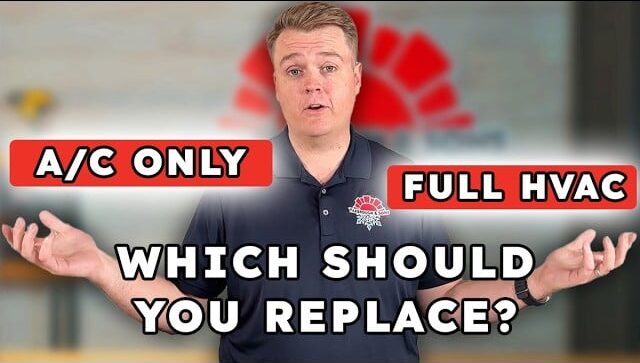
It’s 2026, and as the Oklahoma spring weather begins to heat up, many homeowners are “white-knuckling” their old air conditioners, wondering if they’ll survive another summer. If you find yourself in this position, you face a critical question: Should you replace just the AC unit, or the full HVAC system, including the furnace?
While it may seem like a “gotcha” moment when a contractor suggests a full replacement, there is a technical and financial reality behind that recommendation. Here is the breakdown of the costs, the labor, and why the “full pull” is often the smartest move for your home comfort.
The Cost Breakdown: AC vs. Full System
When we talk about replacing just an “AC system,” we are referring to the outdoor condenser and the indoor evaporator coil. To replace the “full system,” we add the furnace (or the air handler for total electric homes) to that list.
1. Replacing Just the AC and Coil
- Estimated Cost: $7,000 – $9,000
- What you get: You get a brand new outdoor unit and a matching indoor coil. However, you are still relying on your old furnace to move the air. If that furnace is the same age as your old AC, you are essentially leaving a “weak link” in your system.
2. Replacing the Full HVAC System
- Estimated Cost: $10,500 – $12,500
- What you get: You get a brand new condenser, coil, and furnace. This comes with updated warranties for every single component, new heat exchangers, and the latest efficiency technology.
Why the Full Replacement Saves You Money
You might notice that adding a furnace only adds about $2,000 to $3,500 to the total, even though a furnace is a major appliance. This is because of the “Labor Overlap.”
To properly replace an evaporator coil, a technician almost always has to pull the furnace out or dismantle a significant portion of the indoor setup. Since we are already doing the heavy lifting and spending the manpower to get to the coil, the incremental labor to swap the furnace at that same time is minimal.
If you replace only the AC today and the furnace fails next winter, you will have to pay for that full labor charge all over again. By doing them in tandem, you effectively pay for the labor once instead of twice.
The 2026 Reality: Warranties and Mandates
In 2026, the landscape of home comfort is changing. With new Department of Energy efficiency mandates and changes in refrigerants, mismatched systems are becoming harder to maintain.
- Expired Warranties: If you keep your old furnace, you start at “year zero” on your new AC warranty while the furnace warranty remains expired. If a part fails inside that old furnace, you’re looking at an out-of-pocket expense that could have been covered by a new system warranty.
- Peace of Mind: Replacing the full system ensures that all components are designed to work together at peak efficiency, saving you money on your monthly utility bills from day one.
Conclusion: Which Direction Should You Lean?
If your furnace is significantly newer than your AC, a partial replacement might make sense. However, if they were installed at the same time, we highly recommend pulling the trigger on the full system. It saves you money on labor, protects you with fresh warranties, and spares you the heartache of a furnace failure during the first cold snap of winter.
At Yarbrough & Sons, we will do as little or as much as you desire in your home, but we want to make sure you have the facts to make the best long-term investment.
Ready to see what these numbers look like for your specific home?
If you are in the Oklahoma City metro area, you can click the link below to use our Instant Estimate tool. It takes about 45 seconds to see an upfront price for both an AC-only and a full system replacement.
Proudly Serving Communities Throughout The Oklahoma City Area
Our Service Area
 All Service Areas