
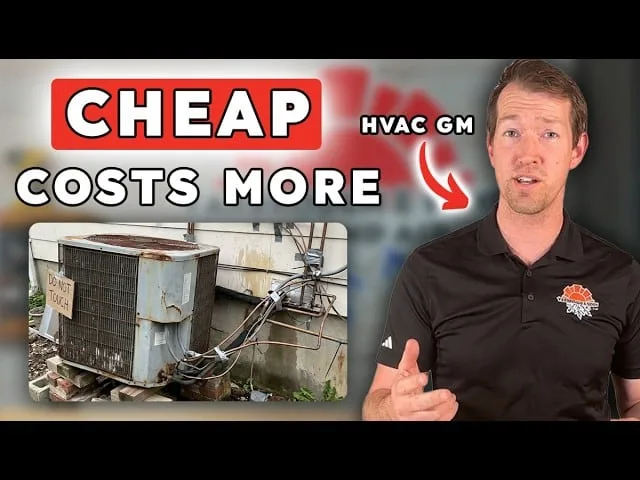
We walk into houses all the time where the homeowner decided to go with the absolute cheapest contractor they could find. In almost every single case, the system wasn’t evaluated properly. We find serious ductwork design flaws, critical refrigerant leaks, and a whole slew of other cutting-corner nightmares.
As a general manager who has spent years in hundreds of attics, mechanical closets, and crawl spaces, I want to show you exactly what cheap HVAC work looks like.
Low-bid contractors aren’t going to show you this behind-the-scenes look. But let’s be honest: everyone wants to be wise with their hard-earned money, and the best way to do that is to avoid cheap, rushed solutions that inevitably turn into incredibly expensive mistakes.
The Ultimate Trap: The $7,000 Install vs. The Real Cost
Let’s preface this whole discussion with a brutal reality check: we want to avoid the $7,000 installation that morphs into a $20,000 nightmare 18 months down the road.
When a contractor targets the absolute bottom dollar, they have to make up their margins somewhere. They achieve this by ignoring your ductwork metrics and putting zero effort into proper system sizing. Fast forward a year and a half later, and your compressor fails prematurely, your house can’t stay cool in the dead of summer, and your electric bills are consistently $200 higher than they should be.
When these homeowners call us out to rectify the situation, we often have to deliver the bad news: the system wasn’t sized right to begin with, the airflow is completely choked, and the entire unit needs to be replaced and re-installed correctly. In the end, they wind up paying more than double what it would have cost to do it right the first time.
Two Red Flags of a Low-Bid HVAC Installation
If you want to spot cheap HVAC work before it destroys your equipment, keep an eye out for these two critical areas:
1. “Flat-Tire” Ductwork
An HVAC unit is only as good as its ability to actually deliver conditioned air to the rooms it’s trying to supply. Hanging a premium, $15,000 high-efficiency air conditioner on a terrible, choked-down duct system is exactly like putting a Ferrari engine inside a car with four flat tires - it isn’t going anywhere.
Cheap installers leave behind ducts that are severely kinked, bent at sharp, restrictive 90-degree angles, or completely disconnected in the attic space, paying to cool your insulation while your bedrooms swelter.
2. Slashed Refrigerant Line Testing
Properly installing a refrigerant line requires strict pressure testing to guarantee there are absolutely zero microscopic leaks. Low-bid installers don’t have the time or patience for that. They simply gas up the system, make sure the air feels cold for the five minutes they are standing there, cash your check, and drive away. You won’t find out you have a slow, constant refrigerant leak until six months later when the summer heat waves hit and your unit suddenly blows warm air.
Where Are These Low-Bid Contractors Coming From?
These unrealistic bids don’t just appear out of nowhere. A massive portion of them are curated by big-name retail lead generation sites like Angie’s List and HomeAdvisor.
At their core, these platforms exist solely to harvest your personal data and sell your clicks to contractors. To get those clicks, they routinely mislead homeowners by publishing articles claiming a central AC replacement only costs about $3,900 with $1,500 in labor.
The 2026 Reality: The national average for a reputable, code-compliant HVAC replacement sits closer to $13,000 to $14,000. Right here in the Oklahoma City metro area, our professional baseline is around $13,000.
When platforms actively push deceptive, rock-bottom numbers, they force a race to the bottom that compromises the quality of the appliances keeping your kids, pets, and family safe.
The Voided Warranty Nightmare
The hidden catch to hiring a “fly-by-night” contractor involves your long-term protection. The average unprincipled HVAC company only stays in business for 2 to 5 years. When they go under, your support goes with them.
While they may pitch you a “10-year manufacturer parts warranty,” manufacturers have incredibly strict guidelines. They require documented verification that the system was installed according to code and maintained through a professional preventative plan. If a low-bid installer skips the registration paperwork and fails to verify the installation metrics, the manufacturer can void your entire 10-year warranty.
Furthermore, parts warranties never cover the cost of specialized labor. Sinking money into an installation with zero labor protection means you’ll still face massive out-of-pocket bills the moment a technical component takes a dive.
Professional demonstration, not a DIY repair guide. Leave electrical, refrigerant, gas, combustion, and specialized installation work to a qualified professional.
Conclusion: Upholding the Standard
This isn’t about punching down on other contractors or tearing competitors apart. This is about upholding and lifting the technical standards that professional, reputable tradespeople fight to maintain every day. If a quote looks too low to be true, steps are being skipped, lines are being cut, and you will eventually pay the difference.
If you are in the Oklahoma City metro area and want a straightforward, meticulously engineered installation that protects your home for the next 15 years, Yarbrough & Sons is in your corner.
Want an honest look at your investment options without any hidden shortcuts? Click the link to use our Instant Estimate and explore estimated pricing for your home. Confirm the final scope and price with our team.